Recipes
Project Year
2018-2026
‘How to make ink out of ashes?’
Collect the ash (preferably black) and grind it into a fine powder. Mix with dirty rainwater collected from a rain gutter. Add rust scraped from metal items for stability. Filter the mixture through a thick cloth. Let it sit. Strain off the upper layer. If the mixture gets thicker, dilute it by adding water.
‘How to remove names from the stone?’
Find a river with a strong current; mountain streams are the best. Submerge the stone where the current is the strongest. Leave it there for years or, if necessary, for decades. Let the water work – day after day, wave after wave – until the letters become part of the riverbed. Check the progress regularly: first, the smallest scratches disappear, then the deeper lines. When the surface is smooth, take the stone.
‘How to clean a self-immolation site’
Industrial ventilator with filters to protect against organic fumes. Thick rubber gloves. Stiff wire brushes. An efficient dry vacuum cleaner. Enzymatic agents for the decomposition of organic matter. Solvent for grease and soot. Ozone generator for three days of continuous work. Concentrated chlorine bleach. Medical waste bags. Containers with biohazard signs. Lye to neutralise acids.
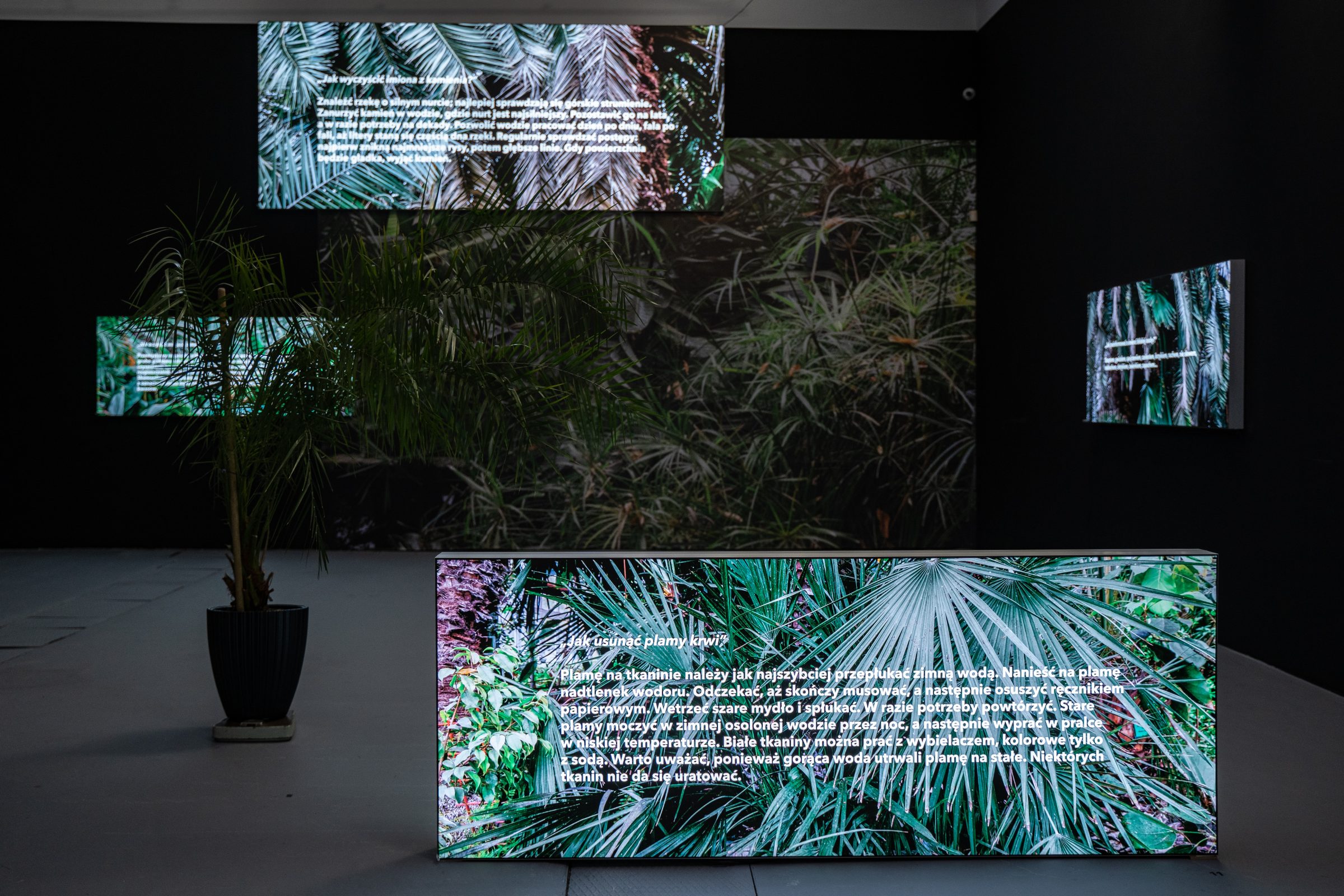
‘How to remove bloodstains’
Rinse the stain with cold water as soon as possible. Apply hydrogen peroxide to the stain. Once foaming stops, blot the area with a paper towel. Rub laundry soap into the stain and rinse. Repeat if necessary. Soak old stains in cold, salted water overnight, then machine wash at low temperature. You can wash white cloths with bleach and coloured cloths with only baking soda. Avoid using hot water, as it will set the stain permanently. Some fabrics may not be salvageable.
‘How to notify of a loved one’s death?
With a whisper, a whistle, a glance, a rustle, a scream, a gesture; not with words but with a breath, touch, a murmur, a scent…
Wandering Through Paradise with a Torch / Recipes
Lightbox series, 2018 – ongoing
The project began in 2018 and continues to grow, absorbing new layers of experience — domestic, military, personal.
The background of each lightbox is a photograph of tropical vegetation taken in the Botanical Garden of Lviv University, directly alongside Lychakiv Cemetery. The dense, lush, almost excessive greenery is the vegetation of Paradise, as it appears in illustrations of the Garden of Eden — an artificial paradise growing beside death; a natural camouflage in which one can disappear, hide, mimic, become part of the background and vanish.
Against this backdrop, texts are printed in a semi-transparent typeface in the form of recipes — practical instructions. Some are domestic, almost neutral: how to remove blood stains, how to clean a site of self-immolation. Some are invented or assembled from real interviews: how to erase a name from stone, how to deliver news of a death, how to make ink from ash. New recipes created during military service add another layer — experience that resists direct expression but finds a form through the genre of instruction.
The lightbox works in two registers at once. The first is aggressive marketing: a backlit advertisement that imposes itself, demands attention, compels the eye. The second is a night-light: the soft glow one falls asleep under, the light that soothes and gives a sense of safety. The two meanings never resolve in favour of one another — they coexist in permanent tension.
To wander through Paradise with a torch is not to see it whole, but only in fragments: a piece of leaf, part of a text, a line of a recipe. The torchlight does not illuminate — it singles things out and deepens the dark around them. The recipes work the same way: each one alone is an instruction; together, they form a landscape in which one is already lost.